To meet&share interests about car. Hope we can improve our knowledge as well!
Showing posts with label Turbo. Show all posts
Tuesday, May 6, 2014
Alternator VR4 / Mirage
Slm. Ada sbijik alternator VR4 nk letgo. Baru barai dr sbuah enjin. Sesuai utk enjin VR4, mirage atau seangkatan dengannya. Brg masih cantik seperti dlm gambar.
Thursday, February 2, 2012
How Turbos Work??
Basically, it sends a larger load of air into the cylinders, thus
increasing the amount of gasoline that can be injected into the combustion
chamber. The consequence is a sharp increase of combustion chamber’s internal
temperature. Turbo charging forces compressed air into an engine to improve a vehicle’s performance. The advantage of compressing the air is that it lets the engine squeeze more air into a cylinder, and more air means that more fuel can be added.
Therefore, you get more power from each explosion in each cylinder. A turbocharged engine produces more power overall than the same engine without the charging. This can significantly improve the power-to-weight ratio for the engine (we will learn on how horsepower works later). On the one hand the air is compressed while its temperature increases and on the other, more burning gasoline produces more heat. With
turbochargers, a smaller, more fuel efficient engine can replace a larger, less
fuel efficient engine. The smaller engine achieves similar performance, while
reducing exhaust emissions.
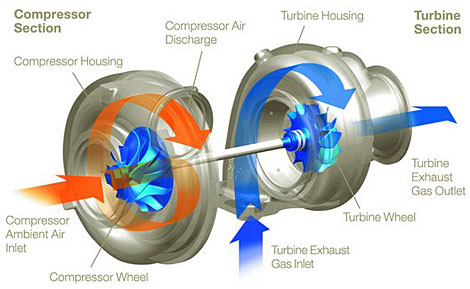
The turbocharger is driven by waste exhaust
gases forced through an exhaust housing onto a turbine wheel. The turbine wheel
is connected by a common shaft to a compressor wheel so that both wheels rotate
simultaneously when the exhaust gases hit the turbine wheel. Rotation of the
turbo assembly compresses the intake air routed through a compressor housing,
forcing the compressed air into the engine’s cylinders. The increased amount of
air forced into the engine creates more power than a similarly sized
non-turbocharged engine and power similar to a larger, non-turbocharged engine.
Turbochargers operate at very high temperatures, high speeds and high
pressures. Optimum performance can only be achieved by the proper operation,
maintenance and service.
Planning
For Changes
So the first issue
you encounter is whether your piston will withstand this temperature (which I
highly doubt). Many of the stock turbocharged gasoline engines spray a stream
of oil around the bottom of the piston to assist in the cooling.
Then you will have
a problem of self-burning gasoline with a high compression ratio (about 11:1).
Either you use a gasoline with 110 octane or you will need to reduce this ratio
below 9:1 by increasing the thickness of the head gasket, for example.
You can’t ignore
the heat issue for too long. Otherwise, your beautiful turbine will blow up at
2 bar with the rods planted in the ground, right from the start. You will also
need to work the management of injection, since the current settings won’t be compatible
with a turbo.
Another thing you
should plan to change: the camshafts.
The phasing and time of initiation of the stock engine might not be compatible
with a turbo.
Only once you have
evaluated all these points can you look at the practical stuff: how to install
a turbo on your block. The installation can be rather complicated, since you
will need to at least provide lubrication for the turbo. Consider changing your
stock intake/exhaust manifolds.
Take a look on this full information video:
Sources:
turbo international
how stuff works
popular mechanics
2L Turbo
wrx
tamparacing
carway
mazdarotary
arturbo uk
Tuesday, April 5, 2011
4G93T GSR


Since Malaysia government had changed the rules and regulation for engine conversion, which all Proton cars except Proton Perdana cannot convert to 2.0L engine, the Mitsubishi Lancer GSR 4G93T is one of the highest horsepower turbo engine that can fit into Proton cars (only applicable for those who wish to register their car to JPJ and legally on the road). From the topic, it is clearly shows that this is the first generation 4G93T GSR 1.8L from the Mitsubishi Lancer. There are two types of engine specification throughout the entire life of the Mitsubishi 4G93T first generation engine. There are the normal version which capable to produce approximately 190hp and the 4G93T RS from the wagon also known as Libero in Malaysia here which able to produce approximately 210hp.
Below are some of the specification of the GSR 1.8L RS.
1. Body: wagon
2. HP: 210bph on flywheel
GSR 1.8RS specs.:
Displacement : 1834 cc
Engine model : 4G93T (turbo)
Max.power (Net),: 150.78kw(205PS)/ 6000rpm
Max.torque(Net): 28.0 kg*m (274.59 N*m) / 3000 rpm
Engine model : 4G93T (turbo)
Max.power (Net),: 150.78kw(205PS)/ 6000rpm
Max.torque(Net): 28.0 kg*m (274.59 N*m) / 3000 rpm
Engine type Water cooling serial 4 cylinder DOHC16 valve IC turbo
Engine information :
Fuel system ECI multiple (electrically controlled gasoline injection)
Turbocharger Turbo with intercooler
Fuel type Unleaded premium gasoline
LEV system (Low emission vehicle) No
Compression ratio : 8.5
Bore : 81mm
Stroke : 89mm
Engine information :
Fuel system ECI multiple (electrically controlled gasoline injection)
Turbocharger Turbo with intercooler
Fuel type Unleaded premium gasoline
LEV system (Low emission vehicle) No
Compression ratio : 8.5
Bore : 81mm
Stroke : 89mm
Here are the normal GSR 4G93T specification. Almost all the GSR in Malaysia are this specification.
Technical Specifications:
TURBO SYSTEM
Make - IHI
Model No - TD04L-13G-5
Waste gate opening pressure - 78 kPa
TURBO SYSTEM
Make - IHI
Model No - TD04L-13G-5
Waste gate opening pressure - 78 kPa
FLUID CAPACITIES (litres)
Engine oil pan(with filter) - 4.0
Engine oil pan(without filter) - 3.8
Manual transaxle -1.8
Engine coolant - 5.0
Reserve tank - 0.7
Fuel tank - 50
Power steering - 0.9
Transfer case - 0.5
Rear differential - 0.8
Engine oil pan(with filter) - 4.0
Engine oil pan(without filter) - 3.8
Manual transaxle -1.8
Engine coolant - 5.0
Reserve tank - 0.7
Fuel tank - 50
Power steering - 0.9
Transfer case - 0.5
Rear differential - 0.8
Manual Transaxle
Hypoid Gear Oil; API classification GL-4 (preferred) or higher
viscosity No. SAE 75/85W, 80W
Hypoid Gear Oil; API classification GL-4 (preferred) or higher
viscosity No. SAE 75/85W, 80W
Rear differential
Gear Oil; API classification GL-5 or higher
viscosity No. SAE 90W or 80W
Gear Oil; API classification GL-5 or higher
viscosity No. SAE 90W or 80W
Transfer
Gear Oil; API classification GL-4 or higher
viscosity No. SAE 75W-85W, 80W
Gear Oil; API classification GL-4 or higher
viscosity No. SAE 75W-85W, 80W
Power steering
Dexron II Automatic transmission fluid
Engine coolant
Mitsubishi Long Life Coolant at the specified concentration by mixing with demineralised or rainwater only.
Front and rear Wheel bearings
Lithium Base "Multi-purpose" E.P No.2 grease
DIMENSIONS (mm)
Overall length -4275
Overall width mm -1690
Overall height mm -1385
Wheelbase mm - 2500
Overall length -4275
Overall width mm -1690
Overall height mm -1385
Wheelbase mm - 2500
Track
- Front -1450
- Rear -1460
Ground clearance mm (unladen) -150
Turning circle - kerb to kerb -10.2m
Seating capacity -5
- Front -1450
- Rear -1460
Ground clearance mm (unladen) -150
Turning circle - kerb to kerb -10.2m
Seating capacity -5
MASS (Kg). This is only applicable for Lancer. For those who convert this engine to Proton Satria, Proton Saga the weight is different compare to Lancer and Wira.
Kerb Mass (with tank of fuel)
1190
GMV
1680
GCM
2430
Air Conditioning
+20
Power Steering
+6
Tow Bar
+15
Anti Skid Braking
+17
GMV = Vehicle Mass + Payload
GCM = GMV + Trailer and Load
TORQUE SPECIFICATIONS(Nm) .
Cylinder head bolts
- hot engine
80-85
- cold engine
t 20 + ¼ + ¼
Camshaft sprocket bolts
90
Camshaft bearing caps
- M6
11
- M8
24
Main bearing cap bolts
*25 + ¼
Crankshaft pulley to sprocket
12-15
Connecting rod cap nuts
*20 + ¼
Crankshaft sprocket bolt
185
Flywheel/drive plate crankshaft bolts
100
t = Tightening angle method after initial tension to 75 Nm then completely loosened.
* = Tightening angle method
GENERAL ENGINE DATA
Engine
1.8litre
Model
4G93
Type
16v Double Overhead Cam
Bore mm
81
Stroke mm
89
Displacement cc 1834
1834
Power Rating DIN 70020
141kW @ 6000 RPM
Torque Rating DIN 70020
249Nm @ 3000 RPM
Compression Ration
8.5:1
Compression Pressure
935kPa
Firing Order
1-3-4-2
Valve clearance (hot)
- Inlet mm
Auto
- Exhaust mm
Auto
Valve Timing Intake Valve Opens BTDC
19deg
Intake Valve Shut ATDC
53deg
Duration
253deg
Spark Plug Type
NKG BK6E
Bosch F7DC
Nippondenso K20P-U
Spark Plug Gap mm
0.7-0.8
ECI Engine timing (with terminal grounded)
5deg BTDC +- 2deg
Idle speed rpm
750+-100
NOTE On vehicles fitted with a catalytic converter a blackened exhaust pipe is a normal condition.
COOLING SYSTEM
Thermostat opens
77 deg C
Radiator cap release pressure
75 to 105 kPa
TRANSAXLE
Type
Manual
Model
W5M33
Gear ratios
5 Speed
1st
2.916
2nd
1.684
3rd
1.115
4th
0.833
5th
0.666
Reverse
3.166
Primary reduction
1.680
Transfer gear
1.090
Final drive gear
- front
2.936
- rear
4.525
BRAKES (mm)
Front
Ventilated Disc
Diameter
204.0
Thickness
- Std mm
24.0
- Min mm
22.4
Lining pad thickness
2.0
Disc run out
0.8
Rear
Solid Disc
Diameter
224.0
Thickness
10.0
Lining pad thickness
2.0
Disc run out
0.8
Wheel speed sensor clearance
- front Fixed
Fixed
- rear
0.3 - 0.9
Master cylinder
Tandem, dual proportioning valve with 'x' split system
Bore diameter
22.2
Booster Master Vac Diameter
180/205
Brake pedal height
162-165
Brake pedal freeplay
3-8
Park brake lever stroke
5 - 7 notches @ 200N
WHEEL ALIGNMENT
Front suspension
McPherson strut, coil spring
Camber (non~adjustable)
0 deg +- 30'
Caster
2 deg 20' +- 30'
Toe-in (measured at centre of tyre tread)
0 +- 3mm
Toe-in Angle
0 deg +-0 deg 9'
Toe-out angle on turns when outer wheel at 20'
21 deg 12'
King-pin inclination
12 deg 49'
Rear suspension
Trailing arm multi link
Camber
0 deg 40' +- 30'
Toe-in (at rim)
0.5 +- 2.5 mm
STEERING GEAR
Type
Rack and pinion
Steering wheel free play
10-30 mm
CLUTCH
Type
Single diaphragm with single dry disc
Diameter
215 x 140 mm
Pedal free play
6 - 13 mm
Pedal height
162 - 165 mm
Release bearing
Self centering type
WHEELS AND TYRES
Wheels
14" x 5.5" JJ
Tyre
195/60R14 85V
Pressure
- Front
210kPa
- Rear
200-210 kPa
Rim runout max lateral\radial
1.0 mm
ELECTRICAL
Battery
272 CCA 49 minutes
Alternator
12v with integrated voltage regulator
Output
65 A
FUEL SYSTEM
Type
Multipoint electronically controlled
Fuel pump
Electric in tank
Pressure
335 kPa
Fuel type
Unleaded petrol only
Kerb Mass (with tank of fuel)
1190
GMV
1680
GCM
2430
Air Conditioning
+20
Power Steering
+6
Tow Bar
+15
Anti Skid Braking
+17
GMV = Vehicle Mass + Payload
GCM = GMV + Trailer and Load
TORQUE SPECIFICATIONS(Nm) .
Cylinder head bolts
- hot engine
80-85
- cold engine
t 20 + ¼ + ¼
Camshaft sprocket bolts
90
Camshaft bearing caps
- M6
11
- M8
24
Main bearing cap bolts
*25 + ¼
Crankshaft pulley to sprocket
12-15
Connecting rod cap nuts
*20 + ¼
Crankshaft sprocket bolt
185
Flywheel/drive plate crankshaft bolts
100
t = Tightening angle method after initial tension to 75 Nm then completely loosened.
* = Tightening angle method
GENERAL ENGINE DATA
Engine
1.8litre
Model
4G93
Type
16v Double Overhead Cam
Bore mm
81
Stroke mm
89
Displacement cc 1834
1834
Power Rating DIN 70020
141kW @ 6000 RPM
Torque Rating DIN 70020
249Nm @ 3000 RPM
Compression Ration
8.5:1
Compression Pressure
935kPa
Firing Order
1-3-4-2
Valve clearance (hot)
- Inlet mm
Auto
- Exhaust mm
Auto
Valve Timing Intake Valve Opens BTDC
19deg
Intake Valve Shut ATDC
53deg
Duration
253deg
Spark Plug Type
NKG BK6E
Bosch F7DC
Nippondenso K20P-U
Spark Plug Gap mm
0.7-0.8
ECI Engine timing (with terminal grounded)
5deg BTDC +- 2deg
Idle speed rpm
750+-100
NOTE On vehicles fitted with a catalytic converter a blackened exhaust pipe is a normal condition.
COOLING SYSTEM
Thermostat opens
77 deg C
Radiator cap release pressure
75 to 105 kPa
TRANSAXLE
Type
Manual
Model
W5M33
Gear ratios
5 Speed
1st
2.916
2nd
1.684
3rd
1.115
4th
0.833
5th
0.666
Reverse
3.166
Primary reduction
1.680
Transfer gear
1.090
Final drive gear
- front
2.936
- rear
4.525
BRAKES (mm)
Front
Ventilated Disc
Diameter
204.0
Thickness
- Std mm
24.0
- Min mm
22.4
Lining pad thickness
2.0
Disc run out
0.8
Rear
Solid Disc
Diameter
224.0
Thickness
10.0
Lining pad thickness
2.0
Disc run out
0.8
Wheel speed sensor clearance
- front Fixed
Fixed
- rear
0.3 - 0.9
Master cylinder
Tandem, dual proportioning valve with 'x' split system
Bore diameter
22.2
Booster Master Vac Diameter
180/205
Brake pedal height
162-165
Brake pedal freeplay
3-8
Park brake lever stroke
5 - 7 notches @ 200N
WHEEL ALIGNMENT
Front suspension
McPherson strut, coil spring
Camber (non~adjustable)
0 deg +- 30'
Caster
2 deg 20' +- 30'
Toe-in (measured at centre of tyre tread)
0 +- 3mm
Toe-in Angle
0 deg +-0 deg 9'
Toe-out angle on turns when outer wheel at 20'
21 deg 12'
King-pin inclination
12 deg 49'
Rear suspension
Trailing arm multi link
Camber
0 deg 40' +- 30'
Toe-in (at rim)
0.5 +- 2.5 mm
STEERING GEAR
Type
Rack and pinion
Steering wheel free play
10-30 mm
CLUTCH
Type
Single diaphragm with single dry disc
Diameter
215 x 140 mm
Pedal free play
6 - 13 mm
Pedal height
162 - 165 mm
Release bearing
Self centering type
WHEELS AND TYRES
Wheels
14" x 5.5" JJ
Tyre
195/60R14 85V
Pressure
- Front
210kPa
- Rear
200-210 kPa
Rim runout max lateral\radial
1.0 mm
ELECTRICAL
Battery
272 CCA 49 minutes
Alternator
12v with integrated voltage regulator
Output
65 A
FUEL SYSTEM
Type
Multipoint electronically controlled
Fuel pump
Electric in tank
Pressure
335 kPa
Fuel type
Unleaded petrol only
** Specifications so marked were correct at time of publication. If these specifications differ from those on the Vehicle Emission Control Label (in the engine bay) use the specification on the label.
Subscribe to:
Posts (Atom)


.jpg)